Numbers
In traditional Kaaryakartaa-Abhichaara Tantric groups the Nirampetian and Odikamuyyan sex rituals can be carried out by two individuals of any sex, or by more than two for larger gatherings and Temple ceremonies. It can be any number of people but there has been a traditional set of grouping numbers that have been used by many Tantric communities in the past, and this is discussed below.
One to One
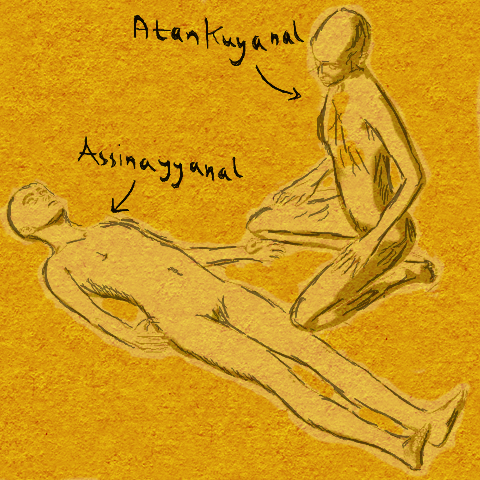
This is usually the standard arrangement. In this arrangement one Aaiyyanist (the Assinayyanal) would lay down and the other Aaiyyanist (the Atankuyanal) would perform the ritual as give by sections 4 and 5 (The Nirampetian and Odikamuyyan Sex Rituals). Once the Assinayyanal has orgasmed the parties would switch places and the Assinayyanal would then perform the ritual on the Atankuyanal until the Atankuyanal reached the point of orgasm.
The order of who goes first is determined and agreed by both parties, but if they carry the ritual out on Day 1, then on Day 2 the order of who goes first would be reversed, e.g. the Assinayyanal on Day 1 becomes the Atankuyanal on Day 2 and performs the ritual first, and each subsequent days both parties switch. In other words the order alternates on different days so as to keep the equilibrium of Talic energy constant. It was found that the Aaiyyanist who receives the ritual first may get a slightly greater input of Tala energy than the second one, so in this regard it is wise to alternate to stop one party gaining too much resonance with the Nirampetian Tala or Odikamuyyan Loka.
Two to One arrangement
In traditional Tantric Aaiyyanist circles it is common for the ritual to be carried out by more than two people. As discussed earlier, the parties can by either male (M), female (F), transgender (T) or no-gender (N) and there can be a mixture of each, e.g. MMM,FFF,TTT,MFT,MMF,MFF,FTT,FTM,TTM,NNN,NFT,NMT,MNN etc...
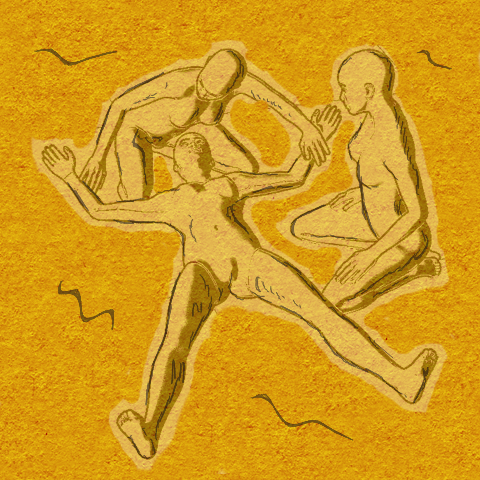
In the two-to-one(2:1) arrangement the Assinayyanal (AS) lays down while one Aaiyyanist (Atankuyanal 1: AT1) performs the ritual on the upper body while the other Aaiyyanist (Atankuyanal 2 : AT2) performs the ritual on the lower body. In this traditional arrangement Aaiyyanist AT2 will bring the Assinayyanal to orgasm via the Petikantanaal ritual (masturbation) or Occiyamanaal ritual (oral sex) and/or use Karuviakaryanal tools (traditional sexual tools). At the same time Aaiyyanist AT1 will perform the advanced Ekkalikkayan ritual (to stop the Tala energy being expelled from the body). This obviously is an advanced technique and must be used with caution but if you follow the sections detailing these advanced rituals then there should be no problems.
As in the 1-1 ritual, after the Assinayyanal has orgasmed then the parties swap/rotate. The Aaiyyanist who was AT2 lays down and becomes the new Assinayyanal (AT2-> AS), and the old Assinayyanal becomes AT1 (AS->AT1) and performs the ritual on the upper body. While the Aaiyyanist who was AT1 becomes AT2 and performs the ritual on the lower body, and then brings the new Assinayyanal (AT2->AS) to orgasm. The new AT1 performs the Ekkalikkayan breath ritual, and the new Aaiyyanist AT2 can perform the Petikantanaal (masturbation) or Occiyamanaal rituals (oral sex), or alternatively use sexual tools (Karuviakaryanal ritual). So in summary all parties rotate and take on their new roles: AS->AT1, AT1-> AT2, AT2->AS.
The ritual is performed in rotation 3 times to ensure all parties have orgasmed. So in one cycle Aaiyyanists: AS AT1 and AT2 will have orgasmed.
Many to One arrangement
In this scenario there are more than three individuals participating in the ritual. In classical Dravidian Aaiyyanist texts on this matter and in traditional Kaaryakartaa-Abhichaara Tantric groups, the ritual is carried out as for the two to one arrangement, i.e. the Assinayyanal (AS) lays down while one Aaiyyanist (Atankuyanal 1: AT1) performs the ritual on the upper body while the other Aaiyyanist (Atankuyanal 2 : AT2) performs the ritual on the lower body.However, there will be other Aaiyyanists, and these are designated AT3, AT4, AT5 etc... These extra Aaiyyanists would engage in the Kattuukkamaal ritual i.e. the ritual of restraint as explained in the section entitled: Kattuukkamaal.
3:1 Ritual - If you had one extra person engaged in the ritual (i.e. AT3) they would perform the Kattuukkamaal ritual on the arms of the Assinayyanal (AS). See figure

4:1 Ritual - If there were 2 extra people engaged then AT4 would perform the Kattuukkamaal ritual on both the legs.
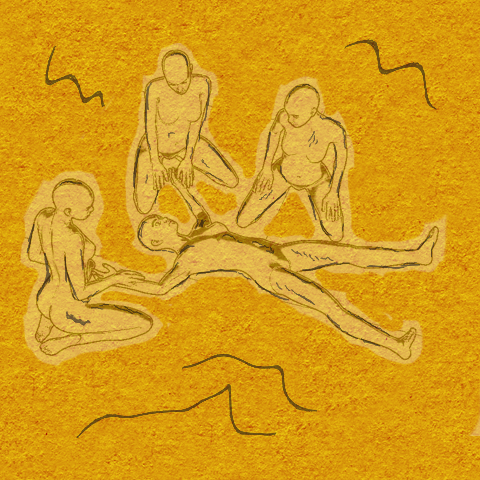
5:1 Ritual - If you had 3 extra people then AT4 and AT5 would perform Kattuukkamaal on the arms (one arm each) and AT6 F would perform Kattuukkamaal on the legs.
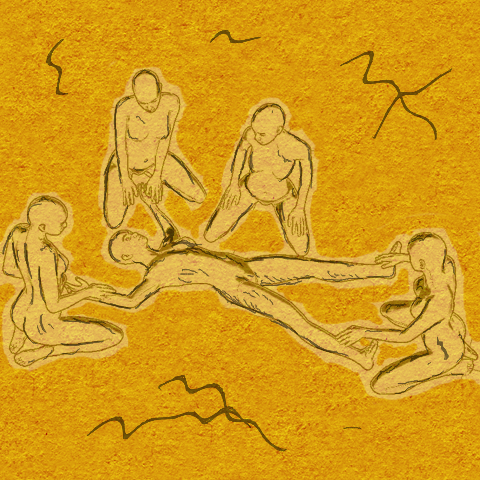
6:1 Ritual - If you had 4 extra people then AT4 and AT5 would perform Kattuukkamaal on the arms (one arm each) and AT 6 and AT7 would perform Kattuukkamaal on the legs as seen in the diagram.
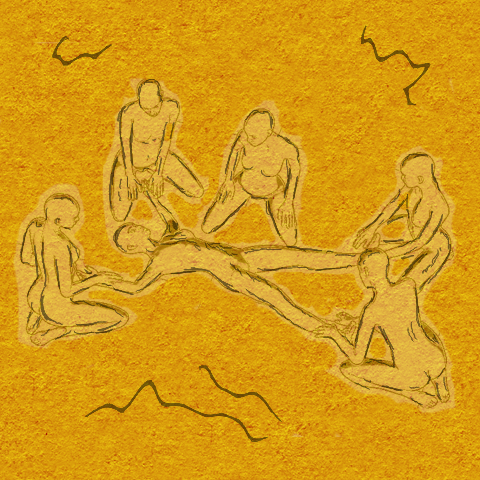
You cannot have more that 7 people in total (including the Assinayyanal) engaged in the ritual in one group at a time. If there are more than 7 then you can create separate rituals in the same room and swap individuals between each group, i.e. have two groups of 3:2 and 2:1. Allow your Aaiyyanist judgment to make the correct ratios to achieve high resonance.
Finally - as in all Nirampetian rituals the process can be repeated over and over until one of the parties has had enough and the level of Tala/Loka energy inside of any of the parties participating is too much, i.e. they will feel too tired and drained. They can rest between the ritual for 30 minutes and repeat, or rest until they are sufficiently replenished and continue. If there are more than two groups engaging in the ritual in a temple room and one person in one group feels too tired to continue, then the other parties may continue without the other one or form a new group with the other groups in the room. People can drop out and drop in during the ritual, but you need at least two people to engage in the ritual to open both the Nirampetian and Odikamuyyan dimensions.